

Board Performance · 2025
In this section15 topics
- Compliance Monitoring — Overview1 item
- Prevention of Conflicts of Interest3 items
- Prevention of the Use of Inside Information3 items
- Anti-Corruption4 items
- Whistleblowing3 items
- Selection of Directors & Chief Executives6 items
- Selection of Independent Directors2 items
- Director Development2 items
- Evaluation of Board & Subcommittee Performance3 items
- Subcommittees1 item
- Meeting Attendance & Remuneration4 items
- Supervision of Subsidiaries & Associated Companies4 items
- Board Duty Performance — Overview1 item
- Audit Committee Duty Performance1 item
- Executive Committee Duty Performance1 item
Compliance Monitoring — Overview
Compliance Monitoring — Introduction
The Company places importance on and encourages executives and employees to apply the policies and practices of good corporate governance, which are specified in the Corporate Governance Policy, Code of Conduct and Anti-Corruption Policy, to their work according to their responsibilities in order to build confidence among all stakeholders, as well as organize activities to provide knowledge or review understanding to promote actual practice.
In 2025 the Company has monitored the implementation of the principles of good corporate governance appropriately and in line with the context of business operations, such as the use and maintenance of internal information and personal information, risk assessment and management and internal control processes, and responsibility towards stakeholders in accordance with the framework of sustainable business development. The monitoring results showed that Amarin Group has implemented each issue appropriately in accordance with the specified policies and practices. In addition, the Company has monitored the implementation of the principles of good corporate governance in the following areas:
Prevention of Conflicts of Interest
Has the Company Acted to Prevent Conflicts of Interest?
Yes
Operations in the Past Year
The Company is committed to conducting business with consideration to the interest of Amarin Group and all stakeholders. Therefore, it is the duty of all directors, executives, and employees, including related persons, to avoid having any stake in or involvement in any activity that may cause a conflict of interest, which may result in Amarin Group losing benefits or having less work efficiency. In addition, if it is necessary to conduct a transaction that would cause a conflict of interest, the directors, executives or relevant departments must supervise the transaction to ensure transparency and clarity for the maximum benefit of Amarin Group. For any transaction that is considered a related party transaction according to the announcement of the SEC, Amarin Group must strictly comply with the criteria and methods specified in the announcement of the SEC and the Stock Exchange of Thailand.
In 2025 the Company monitored compliance with the following guidelines on stakeholder engagement and conflicts of interest:
The Legal and Compliance Office monitors directors and senior executives to update their stakeholder information in December of each year. The Company Secretary also reports the directors' and executives' holdings of the Company's securities to the Board of Directors every quarter, as well as monitors the Company's President and senior executives to comply with the policy when they hold positions as directors and executives in other companies.
The accounting and internal audit departments collect information on transactions between Amarin Group and related persons which are normal business transactions and transactions supporting normal business with trade agreements that contain ordinary trading conditions principally approved by the Board of Directors to report to the Audit Committee every quarter. In addition, for related party transactions that are not normal business transactions and transactions supporting normal business, the management has complied with the criteria of the SEC and the Stock Exchange of Thailand by presenting them to the Audit Committee for consideration and rendering of opinion before presenting them to the Board of Directors for consideration and approval or considering to present them to the shareholders’ meeting for consideration and approval (whatever the case may be, depending on the size of the transaction). In such cases, the directors and/or shareholders who have interest will not have the right to vote, and information on transactions that may have conflicts of interest or related transactions will be disclosed in Form 56-1 One Report.However, in 2025, the Company did not enter into any large-scale transactions with related parties that required shareholder approval.
The Human Resources Department and the Legal and Compliance Office jointly inform executives and new employees to study Amarin Group's Good Corporate Governance Policy and practices, which are part of the employee regulations published on the website or intranet system for all personnel to access. Accordingly, all personnel of Amarin Group and 100% of new personnel in the fiscal year 2024 have signed, acknowledged and agreed to comply with the Good Corporate Governance Policy and practices, including the matters of interests and conflicts of interest.
The Legal and Compliance Office has prepared learning media and tests on the practices on vested interests and conflicts of interest in the e-learning format for directors, executives, and employees to review their understanding of important practices that must be adhered to. The training content explains and presents examples of situations, actions, or relationships that are considered vested interests or may cause conflicts of interest between the personal interests of directors, executives, and employees and the interests of Amarin Group, including practices that should be implemented in each case when conflicts of interest or vested interests occur, in addition to informing about the duties of directors, executives, and employees in disclosing reports of their vested interests and those of their related persons to the Company Secretary or Internal Audit Department in accordance with Amarin Group’s practices. Accordingly, a total of 100 percent of directors, executives, and employees of Amarin Group have reviewed the policies and practices on vested interests and conflicts of interest through the above learning media.
In 2025, the Company did not find any wrongdoing or receive any tips and complaints regarding vested interests and conflicts of interest that violate the criteria of the regulatory agencies and the principles of good corporate governance of Amarin Group
Number of Conflict-of-Interest Cases
| Metric | Current Year | Previous Year | Two Years Ago |
|---|---|---|---|
| Total number of cases or issues related to conflicts of interest (cases) | 0 | 0 | 0 |
Prevention of the Use of Inside Information
Has the Company Acted to Prevent the Use of Inside Information?
Yes
Operations in the Past Year
The Company places importance on various activities to create equality and fairness for all groups of shareholders. As such, publicly undisclosed inside information or news that is important and may change securities prices is considered inside information and is confidential information of Amarin Group. The Company requires directors, executives and employees at all levels to keep inside information confidential and to not disclose inside information that they learn from performing their duties to others or use it to seek profit or benefits from securities trading inappropriately or cause Amarin Group to lose benefits, whether directly or indirectly.
In 2025 the Company will monitor compliance with the policies and practices on the use and confidentiality of internal information as follows:
The Company Secretary will notify the directors, executives, and employees of Amarin Group via email about the blackout period for trading of the Company’s securities one month before the announcement of financial statements and five days after the public has been informed of said information. Every three months, the Company will notify the directors, executives, and employees of the blackout period in trading the Company’s securities, and will notify the directors and executives of the Company (as defined by the SEC) and senior executives of the Company and its subsidiaries of their duties to report changes in their holding of the Company’s securities to the Company Secretary by at least one day in advance of their transactions, in accordance with the Company’s corporate governance principles, and a report must be submitted to the SEC within three business days from the date of purchase, sale, transfer, or receipt of such securities, in the case directors and executives of the Company as defined by the SEC. The Board of Directors has assigned the Company Secretary to submit a summary report of changes in securities holdings of directors and executives to the Board of Directors' meeting for acknowledgement on a quarterly basis.
The Human Resources Department and the Legal and Compliance Office jointly inform executives and new employees to study Amarin Group 's Good Corporate Governance Policy and practices, which are part of the employee regulations published on the website or intranet system for all personnel to access. Accordingly, all personnel of Amarin Group and 100% of new personnel in the fiscal year 2024 have signed, acknowledged and agreed to comply with the Good Corporate Governance Policy and practices, including the matters of interests and conflicts of interest.
The Legal and Compliance Office has prepared learning media and tests on policies and practices regarding the use and maintenance of confidentiality of inside information in E-learning format for directors, executives and employees to review their understanding of important practices that must be adhered to. The training content presents definitions and examples of confidential information and inside information of Amarin Group of Companies, as well as practices for the use, maintenance and disclosure of confidential information and inside information, as well as penalties when practices are violated in various cases. Such as trading in securities using inside information, disclosing the company's confidential information to unrelated persons or using inside information for personal gain, etc., where 100% of the directors, executives and employees of Amarin Group have undergone a review of the policy and guidelines on the use and maintenance of confidentiality of inside information through the aforementioned learning media.
In 2025, the Company did not find any wrongdoing or receive any whistle blow and complaints regarding the use of inside information that violates the criteria of the regulatory agencies and the principles of good corporate governance of Amarin Group and did not find any directors and executives of Amarin Group trading in the Company's shares during the blackout period as prohibited by the Company.
Number of Inside-Information Cases
| Metric | Current Year | Previous Year | Two Years Ago |
|---|---|---|---|
| Total number of cases or issues related to the use of inside information to seek benefits (cases) | 0 | 0 | 0 |
Anti-Corruption
Has the Company Acted on Anti-Corruption?
Yes
Operations in the Past Year
The Company has an Anti-Corruption Policy that prohibits all directors, executives and employees from being involved in any form of corruption and that requires them to strictly comply with the law, policies and practices to prevent corruption. To ensure that the Company has defined the appropriate responsibilities, practices and actions to prevent corruption in all activities of Amarin Group, the Company has established the Anti-Corruption Policy and practices (the “Anti-Corruption Policy”), covering in writing the guidelines on giving and receiving gifts, entertainment, donations, financial support, human resource management and political assistance, which have been approved by the Board of Directors. Its scope of application includes directors, executives and employees at all levels of Amarin Group. Additionally, important guidelines exist for directors, executives and employees of Amarin Group, and the Board of Directors reviews the appropriateness of the Anti-Corruption Policy annually and sets anti-corruption as one of the training topics for new employees and training topics in the annual review of practices in accordance with the Code of Conduct.
Furthermore, the Company has established an appropriate risk management system to effectively monitor and manage corruption risks. The Internal Audit Department is responsible for inspecting and reviewing the performance of various departments to comply with the law and policies or procedures of Amarin Group and to reduce the occurrences of corruption, and the department will report its findings to the Audit Committee and the Board of Directors. Additionally, multiple channels are provided to receive complaints or information about suspected acts of corruption from stakeholders both inside and outside the organization, and the process for receiving complaints and measures to protect whistleblowers have been clearly set. The summary of the Company’s Anti-Corruption Policy is disclosed in Section 6.1.1, Sub-item (17) “Anti-Corruption” of this Form 56-1 One Report, as well as in the Anti-Corruption Policy under the “Corporate Governance” section on the Company’s website at www.amarin.co.th.
In 2025 Amarin Group implemented the Anti-Corruption Policy and practices as summarized below:
The Company and its subsidiaries assessed the opportunities and potential impacts of corruption risks on a quarterly basis, and the Internal Audit Department reviewed Amarin Group 's significant transactions, which may have steps or processes that are at risk of corruption, such as the procurement of high-value goods and services, requests for benefits during the application process for licenses related to business operations, or whenever there were complaints about environmental impacts from communities surrounding the subsidiaries' premises.
In 2025, the internal audit found no corruption-related activities and no information or complaints about corruption were received from stakeholders
The Company published its Anti-Corruption Policy and practices through various communication channels, including website, email, brochures, intranet, and internal corporate public relations media to inform all relevant parties and request compliance cooperation. For example, around New Year every year, the Company sends a letter informing trading partners to raise awareness and request cooperation in complying with the policy of not accepting gifts, assets or any other benefits, and the policy of not accepting gifts for all festivals and all occasions is published on the Company’s website.
The Human Resources Department and the Legal and Compliance Office jointly informed executives and new employees to study Amarin Group’s Good Corporate Governance Policy and Practices, which are part of the employee regulations and published on the website or intranet system that all personnel can access. All personnel of Amarin Group and 100% of new personnel in 2025 have signed an acknowledgement and agreed to comply with the Good Corporate Governance Policy and Practices, including the Anti-Corruption Policy.
In addition, the Legal and Compliance Office had prepared and published learning media and tests in the e-learning format to review the understanding of important practices that must be adhered to in combating corruption, and up to 100% of the directors, executives, and employees of Amarin Group have already reviewed the Anti-Corruption Policy and practices through said learning media.
On 26 June 2024, the Company declared its intention to join the Thai Private Sector Collective Action against Corruption (“CAC”) and subsequently passed the assessment and was first certified as a member of the Thai Private Sector Collective Action against Corruption (Collective Action Coalition Against Corruption: CAC) in September 2025. The certification is effective from 30 September 2025 to 30 September 2028, reflecting the Company’s commitment to conducting business with transparency and good corporate governance. In this regard, the Board of Directors’ Meeting No. 5/2025 held on 4 December 2025 reviewed and approved the revised Anti-Corruption Policy to ensure alignment with the guidelines and criteria prescribed by CAC. In 2025, no complaints relating to corruption were reported. The Company will continue to monitor and oversee compliance with its anti-corruption measures on an ongoing basis.
Form of Anti-Corruption Operations
| Operation |
|---|
| Review of appropriateness in anti-corruption |
| Assessment and identification of corruption risk |
| The participation in anti-corruption projects |
| Communication and training for employees on anti-corruption policy and guidelines |
| The monitoring of the evaluation of compliance with the anti- corruption policy |
| Review of the completeness and adequacy of the process by the Audit Committee or auditor |
Number of Corruption Cases
| Metric | Current Year | Previous Year | Two Years Ago |
|---|---|---|---|
| Total number of cases or issues related to corruption (cases) | 0 | 0 | 0 |
Whistleblowing
Has the Company Implemented Whistleblowing Procedures?
Yes
Operations in the Past Year
Whistleblowing
The Company has established a policy for receiving complaints, channels for whistleblowing, and protection of the rights of whistleblowers in order to provide channels for all groups of stakeholders, both inside and outside the Company, to report clues or complaints in cases where there is suspicion of illegal acts or behavior that indicates corruption or a violation of the Company's Corporate Governance Policy and Code of Conduct, including any suspicious activity related to money laundering, suspicions related accounting, finance, internal control and internal auditing, along with reporting or complaining about rights violations and expressing opinions, suggestions, complaints, etc. as related to the Company. The channels are as follows:
Whistleblower Report Handlers
Chairman of the Audit Committee.
Corporate Governance Committee
Company Secretary / Legal and Compliance Office.
Complainants must specify the details of the matter to be reported, complaints or suggestions regarding corruption, along with their name, contact address and telephone number by making their submission to one of the following channels:
Whistleblowing and Complaint Handling Process
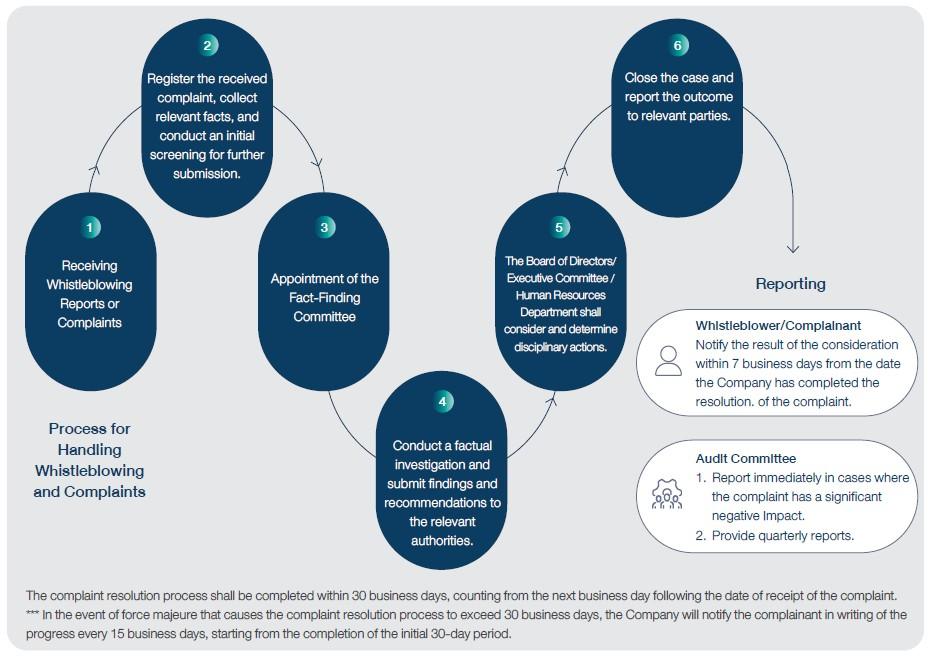
After the Company has received a tip or complaint and conducted a preliminary investigation and it is found that the tip or complaint is true and substantial, the fact-finding team, which is independent in its duties, will coordinate with senior executives and relevant departments to collect data, process, investigate, resolve problems, and determine appropriate and fair mitigation measures for those affected, in accordance with the procedures specified in the Whistleblower and Whistleblower Policy, as well as report the Company’s findings to the informant or whistleblower, and all information will be reported to the President, and the Audit Committee, which consists of independent directors, and the Board of Directors (depending on the case).
Measures to Protect Whistleblowers or Complainants
The Company will keep the information, name and personal data of whistleblowers, complainants and persons subjected to complaints as confidential information and will not disclose the information to other persons who do not have related duties, except when disclosing in accordance with the law, while taking into account the safety and damage of the reporter, source of information or related persons who have been damaged, through appropriate and fair processes. In doing so, if the executives or employees that the Company has investigated and found to have committed a violation of the Company’s business ethics or policies, such as corruption, intellectual property violation, human rights violation, etc., the person will be subject to disciplinary action in accordance with the Company's regulations and/or be punished according to relevant laws.
The Whistleblower Policy is shown under the heading “Corporate Governance” on the Company’s website at www.amarin.co.th. In 2025, the Company and its subsidiaries did not find any wrongdoing that violated the Code of Conduct or received any information or complaints from any stakeholders.
Number of Whistleblowing Cases
| Metric | Current Year | Previous Year | Two Years Ago |
|---|---|---|---|
| Total number of cases or issues received through whistleblowing channels (cases) | 0 | 0 | 0 |
Selection of Directors & Chief Executives
Directors & Chief Executives — Introduction
Selection of Directors and Executives
According to the Company's regulations, persons to be elected as directors and executives of the Company must have all the qualifications as specified in Section 58 of the Public Limited Companies Act, B.E. 2535 (1992), and the Securities and Exchange Act, B.E. 2535 (1992), including not having any prohibited characteristics as specified by law in the selection and election of directors.
The Board of Directors currently consists of 12 directors. The persons nominated for directorship must go through a transparent selection process, as detailed below:
Selection Criteria
The Nomination and Remuneration Committee will consider and select individuals who fully possess the required qualifications and do not have any prohibited characteristics under applicable laws and regulations, and who demonstrate integrity, ethical conduct, and accountability. Such individuals shall be capable of performing their duties with due care (Duty of Care) and in good faith and loyalty to the Company (Duty of Loyalty), for appointment as directors of the Company and members of sub-committees (as applicable). The nomination and selection process shall be conducted in accordance with the Company’s director nomination and appointment criteria prior to submission to the Board of Directors and/or the Annual General Meeting of Shareholders for consideration and approval, as the case may be.
Selection Sources
The Nomination and Remuneration Committee will select qualified individuals to be directors of the Company from the following sources:
1. Suggestions or recommendations from the Board of Directors.
2. Granting of rights to minority shareholders of the company to nominate directors
3. Nomination of qualified individuals proposed by major shareholders for consideration and election as directors of the Company.
4. Director pool database of the Thai Institute of Directors.
Re-election of Directors Whose Terms Have Expired
The Nomination and Remuneration Committee will consider and select individuals who fully possess the qualifications as prescribed by the Company, including qualifications in compliance with applicable laws and relevant regulations as follows;
The Public Limited Companies Act B.E. 2535 (1992).
The Securities and Exchange Act B.E. 2535 (1992).
The Corporate Governance Code for Listed Companies 2017 (CG Code) issued by the Office of the Securities and Exchange Commission (SEC).
The Company’s Articles of Association.
The Company’s Corporate Governance Policy.
The Company’s Business Code of Conduct .
ther applicable laws and regulations relating to the qualifications of directors of listed Companies.
Potential conflicts of interest or related party interests that may arise with the Company.
Diversity of knowledge, competencies, professional skills, expertise, and specific experience that are beneficial and aligned with the Company’s business strategies, as reflected in the Board Diversity Matrix, such as business management, accounting, legal affairs, printing and packaging business, television business, mass media business, exhibition business, publishing business, and distribution business. Diversity in the composition of the Board of Directors, including gender diversity. Diversity in race and nationality, without discrimination on the grounds of gender, race, nationality, skin color, ethnicity, or religion, as well as an appropriate proportion of independent directors in accordance with good corporate governance principles.
In the case of a proposed appointment of an independent director, additional consideration shall be given to the independence qualifications in compliance with the notifications of the Capital Market Supervisory Board and the Company’s definition of independent director qualifications.
In the case of the reappointment of an existing director, consideration shall be given to the individual’s performance during the previous year, both in the capacity as a director and as a member of sub-committees, including constructive opinions and recommendations beneficial to the Company’s business operations, the ability to devote sufficient time to the performance of duties as a director, and participation in Board-related activities, in addition to the criteria specified above.
Nomination of a Director to Fill a Vacancy Other Than Retirement by Rotation
In the event of a vacancy in the Company’s Board of Directors, the Nomination and Remuneration Committee is responsible for selecting new directors. The criteria and selection process are transparent, i.e., by considering the qualifications, experience, knowledge and skills in work, necessary skills and expertise that are still lacking in the Board of Directors, while also ensuring with the diversity of the Board of Directors’ structure in other aspects such as age, sex, education, etc., in accordance with the Board Diversity Policy. This includes consideration of their vision, leadership, ethics, independence, and the ability to devote sufficient time to perform duties for the Company, in addition to having qualifications that comply with the laws and regulations of relevant regulatory agencies, such as the Securities and Exchange Act B.E. 2535 (1992), etc. The Nomination and Remuneration Committee will develop a board diversity matrix to determine the qualifications of the directors to be recruited, while considering the necessary skills that are still lacking in the Board of Directors, along with current and future business strategies or goals. For example, if the Company has a strategy or goal to invest in or operate a new business in addition to the current business, the selection of directors must consider those with qualifications, knowledge, experience, and expertise that match the new business to be invested or operated. The Nomination and Remuneration Committee will initially approach and obtain consent from nominated candidates and conduct a preliminary assessment of their qualifications before proposing the nominees, together with their qualifications and the rationale for selection, to the Board of Directors and/or the shareholders' meeting for consideration and approval (whatever the case may be)
Qualifications of Directors and Independent Directors
Qualifications of the Board of Directors
Directors of the Company must be persons with knowledge, capability, honesty and business ethics, and must possess sufficient time to devote their knowledge, capability and duties to the Company. They also must have the necessary qualifications that are consistent with the Company's business strategy.
The Company's directors must possess qualifications without the prohibited characteristics as specified in laws governing public limited companies, securities and exchange laws, and other relevant laws, including not having characteristics that indicate a lack of suitability to be entrusted to manage a business with the public as shareholders as specified by the SEC
Directors of the Company may hold directorship positions in other companies, but such positions must not be an obstacle or affect the efficiency of the Company’s directorship, and must comply with the guidelines set by the SEC and the Stock Exchange of Thailand (“SET”). Directors are prohibited from engaging in businesses of the same nature and in competition with the Company’s business, and are prohibited from becoming partners or directors of other juristic persons of the same nature and in competition with the Company, unless the meeting concerned is notified before passing the appointment resolution.
Directors should hold positions in no more than five (5) listed companies to enable them to effectively perform their duties as directors of the Company and to devote sufficient time to performing their duties as directors.
Qualifications of Independent Directors
The Board of Directors defines the Company's independent directors in accordance with the announcement of the Capital Market Supervisory Board and the principles of good corporate governance, by defining them as directors who do not perform executive roles, who are independent from the management and controlling shareholders, and who have no business relationship with the Company and its subsidiaries in a manner that would limit their independent expression of opinions. This is to build confidence among investors and maintain a balance in good management. In addition, the Board of Directors has set the qualifications of independent directors more stringently than the criteria set by the Securities and Exchange Commission, as follows:
Holding shares by no more than 0.50% of the total number of voting shares of the Company. This includes shares held by related persons of the independent director.
Not being or having been a director who participated in the management of the company, employee, staff, salaried consultant, or controlling person of the Company*, unless having ceased to have such characteristics for at least 2 years.
Not being a person related by blood or by legal registration to another director, executive of the Company, major shareholder, controlling person, or a person to be nominated as a director, executive or controlling person of the Company or subsidiary.
Not having or having had a business relationship with the Company* in a manner that may interfere with the exercise of independent judgment, including not being or having been a significant shareholder or controlling person of a person with a business relationship with the Company*, unless such a relationship has ended for at least 2 years.
Not being or having been an auditor of the Company* and not being a significant shareholder, controlling person, or partner of an audit firm that employs auditors of the Company, unless the person has ceased to have such characteristics for at least 2 years.
Not being or having been a provider of any professional services, including legal or financial advisory services, who received a service fee of more than 2 million baht per year from the Company, and not being a significant shareholder, a person with controlling authority, or a partner of such professional service provider, unless the person has ceased to have such characteristics for at least 2 years.
Not being a director appointed to represent the Company's directors, major shareholders, or shareholders who are related to major shareholders.
Not engaging in a business of the same nature and in significant competition with the business of the Company or its subsidiaries, or not being a significant partner in a partnership, or being a director who participates in the management, an employee, a staff member, a consultant who receives a regular salary, or holding more than 1% of the total number of shares with voting rights of another company which is engaged in business of the same nature and in significant competition with the Company or its subsidiaries.
Having no other characteristics that make it impossible to express independent opinions regarding the operations of the Company, including the parent company, subsidiaries, affiliates, major shareholders or controlling persons of the Company.
In the case of a proposed appointment of an independent director, additional consideration shall be given to the independence qualifications in compliance with the notifications of the Capital Market Supervisory Board, as well as the Company’s definition of independent director qualifications.
After being elected as an independent director who meets the above qualifications, the independent director may be assigned by the Board of Directors to make decisions on the operations of the Company, subsidiaries, associates, subsidiaries of the same tier, major shareholders or controlling persons of the Company, in the form of collective decisions.
In 2025, no independent director had a business relationship or provided professional services to the Company, its subsidiaries, affiliates, major shareholders or controlling persons of the Company.
Appointment and Removal of Directors
The shareholders' meeting will elect directors by a majority vote according to the following criteria and methods:
Each shareholder has one vote per share.
Each shareholder must use all of his/her votes to elect one or more persons as directors, and he/she may not divide his/her votes for any other person.
Persons who receive the highest number of votes in descending order will be elected as directors according to the number of directors to be elected at that time. In the event that persons elected in descending order receive an equal number of votes, exceeding the number of directors to be elected at that time, selection will be made by drawing lots in order to obtain the number of due directors to be elected.
At every annual general meeting of shareholders, the Company has determined that one-third of the total number of directors must retire from office. If the number of directors cannot be
divided evenly into three parts, the number closest to one-third must retire. The directors who must leave office in the first and second years after the Company’s registration must be determined by the drawing of lots. In subsequent years, the directors who have been in office the longest must retire. However, the directors who have vacated their positions are eligible for reelection. In voting to elect the Company’s directors, shareholders must use ballots or vote via the electronic meeting system to elect directors individually. Each director must receive a majority vote of the shareholders in attendance at the meeting who voted.
The shareholders' meeting may vote to remove any director from office before the expiration of his term by a vote of not less than three-quarters of the number of shareholders attending the meeting and having the right to vote, and whose combined shares are not less than half of the number of shares held by the shareholders attending the meeting and having the right to vote at that meeting.
Election of Directors by the Board of Directors
In the event that a director's position becomes vacant for reasons other than the term expiration, the Board of Directors will consider electing a person who possesses qualifications without the prohibitions by law to be a director in the next Board of Directors' meeting by a vote of not less than three-quarters of the number of remaining directors. The person elected to become the replacement director will remain in office only for the remaining term of the director who has left office, unless the remaining term of the director is less than two months.
Rights of minority shareholders on director appointment
In 2025, the Company granted minority investors the right to participate in the director nomination process by providing shareholders with the opportunity to propose agenda items and nominate qualified candidates for consideration for election as directors of the Company at least 90 days prior to the Annual General Meeting of Shareholders. The Company publicly disclosed the relevant criteria and procedures on its website and informed shareholders through the information disclosure system of the Stock Exchange of Thailand during the period from 9 December 2024 to 10 February 2025. However, no director candidates were nominated by shareholders for consideration by the Nomination and Remuneration Committee.
List of directors whose terms have ended and have been reappointed
In 2025 there were no candidates nominated by shareholders to the Nomination and Remuneration Committee for consideration. Therefore, the Nomi- nation and Remuneration Committee considered the re-election of 4 directors whose terms were due to expire at the 2025 Annual General Meeting of Share- holders to resume their positions as directors for another term as follows:
Mr. Thapana SirivadhanabhakdiPositionVice Chairman
Mrs. Tongjai ThanachananPositionDirector
Prof. Dr. Nantawat BoramanandPositionIndependent Director
Associate Prof. Dr. Somjai PhagaphasvivatPositionIndependent Director
Consideration was given to educational qualifications, skills, work experience, past performance, willingness and time to devote to the Board, as well as other qualities in line with the Company's business strategy.
Number of directors from major shareholders
In 2025, the Board included one director nominated by a major shareholder.
Selection of Senior Executives
The Nomination and Remuneration Committee is responsible for selecting and recruiting individuals who possess all the qualifications as specified in the criteria to hold senior executive positions from the level of Managing Director and above. The primary criteria for consideration include qualifications, knowledge, ability, business experience, management ideas and vision that are in line with the Board of Directors in order to ensure that the organization’s operations will be successful in accordance with set goals. The Nomination and Remuneration Committee will propose the names of people who pass the selection process to the Board of Directors for consideration, in accordance with the specified framework of its charter.
Succession Plan
The Company has a plan to recruit and select personnel to take responsibility in important senior executive positions appropriately and transparently in order to reduce the problem of staff shortages in important positions. The Board of Directors has assigned the Nomination and Remuneration Committee to recruit and select suitable persons to hold the positions of President and senior executives, including preparing and reviewing the succession plan for suitable individuals in terms of age, qualifications, and work experience, while focusing on recruiting new talents to create readiness for everyone to have the opportunity to grow and advance to the executive level in the future through a high-potential assessment process. Every individual will receive development according to an individualized plan, as well as challenging assignments, and job rotation to develop leadership skills and knowledge in all aspects of work, with periodic monitoring and evaluation. These preparations of Amarin Group’s personnel are carried out among employees at all levels to ensure readiness to replace vacant positions and ensure work continuity and effectiveness.
The Board of Directors has assigned the Executive Committee and the President to recruit and select suitable persons to hold senior executive positions in various departments and jointly develop a succession plan by identifying qualified individuals as potential replacements and establishing a personnel development system in the lower tier according to the plan for each individual, in addition to assigning challenging tasks to prepare for assuming such positions. The selection process and succession plan for senior executives are summarized as follows:
The Nomination and Remuneration Committee considers the qualifications, knowledge, skills and experience of senior executives, including the President, Vice President, and managing directors of each work area. Selection will occur in accordance with the selection process of the Nomination and Remuneration Committee, which will consider senior executives from inside or outside the organization who possess the qualifications, knowledge and skills according to the specified criteria and who have the potential to succeed in each work area.
The President is responsible for evaluating the knowledge and skills of executives within the organization who have good qualifications and performance that are consistent with the desired competency levels in order to create individualized development plans. The Human Resources Department is assigned to oversee and ensure that successors receive appropriate training and development of knowledge and skills in related areas in order to be ready to assume their positions.
The President may assign qualified executives to perform or take on challenging duties in order to assess their potential and consider their readiness to be successors, and may assign such executives to attend meetings of the Executive Committee to gain knowledge and understanding of the overall picture of Amarin Group and prepare for future corporate management.
The Executive Committee and the President will report the performance and progress of the individualized development plans of qualified executives to the Nomination and Remuneration Committee at least once a year and whenever there are significant changes.
The Nomination and Remuneration Committee reviews and summarizes the results of the succession plans of the President and senior executives in each work area to report to the Board of Directors at least once a year and whenever there are any significant changes.
In 2025, the Executive Committee and the President made 1 report concerning the above as an annual succession plan report. The Executive Committee has applied the synergy working policy in the successor development process by emphasizing the integration of abilities, good communication, support and sharing, and mutual development and learning. Working together in a synergis tic manner will enable effective and rapid training and learning from the experiences of seniors or those with experience in their positions. This will help strengthen good relationships between both old and new team members, which is important for succession because it will help transfer knowledge and promote smooth work activities. Good relationships help bridge the gap between leaders and their successors, thereby enabling an efficient succession process.
The Board of Directors believes that working in a synergetic way will help succession plans not only change executives from one person to another but also develop the knowledge and skills of future executives, thus smoothly promoting transition within the organization without affecting the performance of the team and the organization as a whole.
Are Directors Selected Through the Nomination Committee?
Yes
Are Chief Executives Selected Through the Nomination Committee?
Yes
Number of Directors from Major Shareholders
1
Rights of Minority Shareholders on Director Appointment
In 2025, the Company granted minority investors the right to participate in the director nomination process by providing shareholders with the opportunity to propose agenda items and nominate qualified candidates for consideration for election as directors of the Company at least 90 days prior to the Annual General Meeting of Shareholders. The Company publicly disclosed the relevant criteria and procedures on its website and informed shareholders through the information disclosure system of the Stock Exchange of Thailand during the period from 9 December 2024 to 10 February 2025. However, no director candidates were nominated by shareholders for consideration by the Nomination and Remuneration Committee.
Method of Director Appointment
| Method |
|---|
| Method whereby each director requires approval votes more than half of the votes of attending shareholders with voting rights |
Selection of Independent Directors
Criteria for Selecting Independent Directors
Qualifications of Independent Directors
The Board of Directors has defined the definition of Independent Directors of the Company in accordance with the Notification of the Capital Market Supervisory Board and the principles of good corporate governance, which means directors who do not act as executives, are independent from management and controlling shareholders, and have no business relationships with the Company and its subsidiaries in a manner that would restrict their ability to express independent opinions in order to build confidence among investors and maintain a balance of good corporate governance. The Board of Directors has established more stringent qualifications for Independent Directors than the criteria set by the Capital Market Supervisory Board, as follows:
Holds no more than 0.50% of the total voting shares of the Company*. This includes the shareholding of the related persons of such Independent Director.
Is not or has never been a director who participates in management, employee, officer, consultant who receives regular salary, or person with control of the Company*, unless such person has ceased to hold such position for at least 2 years.
Is not a person who has a blood relationship or is related by registration under the law to other directors, executives of the Company, major shareholders, persons with control, or persons to be nominated as directors, executives, or persons with control of the Company or its subsidiaries.
Does not have or has never had a business relationship with the Company* in a manner that could hinder the exercise of their independent judgment, including not being or having never been a significant shareholder or person with control of a person who has a business relationship with the Company*, unless such person has ceased to hold such position for at least 2 years.
Is not or has never been an auditor of the Company* and is not a significant shareholder, person with control, or partner of an audit firm that has an auditor of the Company, unless such person has ceased to hold such position for at least 2 years.
Is not or has never been a provider of any professional services, including legal or financial advisory services, who receives service fees exceeding 2 million Baht per year from the Company, and is not a significant shareholder, person with control, or partner of such professional service provider, unless such person has ceased to hold such position for at least 2 years.
Criteria
In the event of a vacancy on the Board of Directors, the Nomination and Remuneration Committee is responsible for considering and recruiting new directors. The criteria and nomination process are transparent, taking into account qualifications, experience, and work ability, as well as necessary expertise that is lacking on the Board of Directors. This is done in conjunction with considering the diversity of the Board's structure in other areas such as age, gender, and education, in accordance with the Board Diversity Policy. Other considerations include vision, leadership, ethics, independence, and the ability to devote sufficient time to the Company. The candidate must also possess qualifications that comply with the law and the requirements of relevant regulatory agencies, such as the Securities and Exchange Act B.E. 2535. The Nomination and Remuneration Committee will prepare a Board Skills Matrix to determine the qualifications of the directors to be recruited, considering the necessary skills that are lacking on the Board of Directors and the Company's current and future business strategies or goals. For example, if the Company has a strategy or goal to invest in or operate a new business in addition to its existing business, the recruitment of directors must consider individuals with qualifications, knowledge, experience, and expertise that align with the new business to be invested in or operated. The Nomination and Remuneration Committee will approach and initially assess the qualifications of the nominees for directorships before submitting their names, qualifications, and reasons for selection to the Board of Directors and/or the shareholders' meeting for approval (as the case may be).
Where the appointment of an independent director is proposed, the Company shall consider the independence qualifications in compliance with the notifications of the Capital Market Supervisory Board, together with the Company’s definition and criteria of independent director qualifications.
Did Any Independent Director Have a Business or Professional Relationship?
No
Director Development
Development of Directors in the Past Year
Continuous Knowledge Development
The Board of Directors has a policy to encourage directors to receive training courses related to the performance of duties of directors as organized by the IOD, including continuous knowledge development to help support the Board's work to be more efficient. In 2025, there were 12 directors who received training courses related to the performance of duties of directors organized by the IOD, totaling 100 percent of all directors, and all directors participated in training, seminars or activities that increased knowledge and/or were beneficial to the performance of duties of directors.
Directors Orientation
In the event that a new director is elected, the Company prepares for the newly elected director to become a director by assigning the Company Secretary to arrange a meeting between the new director, existing directors, and the Company’s senior executives to ensure that the new director is informed and is able to inquire about the Company’s business operations and other relevant information, such as the vision, mission, business nature, capital structure, shareholders, goals, and performance in the past and present for businesses and various tasks, meeting minutes of the Board of Directors and subcommittees for at least the past year, etc. The Company will also provide a company introduction document or other documents that are beneficial to the performance of duties as directors to the newly elected director, such as the Public Limited Companies Act, B.E. 2535 (1992), the charters of the Board of Directors and subcommittees, a manual on good practices for directors of listed companies, the Company’s Corporate Governance Policy and Code of Conduct, the memorandum of association, the Company’s affidavit, the Company’s regulations and rules, and the annual information disclosure form, etc. In 2024, the Company did not elect new directors. However, the Company has consistently provided information or criteria related to the performance of the director’s duties as issued by relevant regulatory agencies, to the Board elected director, such as the Public Limited Companies Act, B.E. 2535 (1992), the charters of the Board of Directors and subcommittees, a manual on good practices for directors of listed companies, the Company’s Corporate Governance Policy and Code of Conduct, the memorandum of association, the Company’s affidavit, the Company’s regulations and rules, and the annual information disclosure form, etc. In 2025, the Company did not elect new directors. However, the Company has consistently provided information or criteria related to the performance of the director’s duties as issued by relevant regulatory agencies, to the Board of Directors and subcommittees so that the directors are informed of up-to-date information and news that are beneficial to the performance of the director’s duties.
New Director Orientation Activity Schedule
Topic | Details / Contents | Person in Charge |
1. pening remarks |
| Company Secretary |
2. Official welcome for the new board members |
| Company Secretary |
3. Business overview |
| President |
4.Roles, duties andresponsibilities f theBoard |
| Senior Board Member |
5. Business strategy and direction |
| President |
6. Board calendar |
| Company Secretary |
7. Q&A |
| All participants |
Information List for New Directors
Company Overview | Key Corporate Policies | Board of Directors information |
|
|
|
Financial information | Work process | Other information |
|
|
|
In addition, throughout year 2025, the Company Secretary regularly reported information or criteria, laws and regulations, announcements, and requirements related to the performance of directors, as issued by relevant regulatory agencies, to the Board of Directors and subcommittees to ensure that directors are informed about current information, which is beneficial to the performance of directors.
Qualifications for Director Selection
| Qualification | Skill & Expertise |
|---|---|
| Knowledge and expertise in business management, accounting, law, printing and packaging business, television business, mass media business, exhibition business, publishing business, and product distribution business. | 135 · Description: Media & Publishing · 141 · Description: Law · 142 · Description: Marketing · 1683 · Description: Business Administration · 3271 · Other name: Television Business / Mass Media Business / Product distribution business. · Description: Others |
Evaluation of Board & Subcommittee Performance
Criteria for Evaluating Board Performance
The Board of Directors has determined that the performance of the Board of Directors and sub-committees be evaluated annually to develop work efficiency. The Corporate Governance Committee is assigned to consider and propose guidelines or evaluation forms to the Board of Directors for approval, as well as to report the evaluation results to the Board of Directors. The evaluation forms are divided into 3 types:
(1) Board of Directors Evaluation Form
(2) Individual Director Evaluation Form
(3) Evaluation Form for all Sub-Committees
which has criteria in accordance with the Stock Exchange of Thailand's assessment form. The performance evaluation is an important tool in assessing the appropriateness of the Board structure and the effectiveness of the Board's performance in accordance with good corporate governance principles. The Board of Directors and sub-committees will analyze the evaluation results, suggestions, and observations to determine guidelines for improving the effectiveness of the Board and sub-committees to be in line with the business environment and regulations that change from time to time appropriately.
Evaluation of Board Performance in the Past Year
The Company conducts performance evaluations of the Board of Directors, sub-committees, and individual directors in December of each year. The Company Secretary prepares and reviews the performance evaluation forms to ensure accuracy and completeness before submitting them to the Board of Directors for consideration. The Company Secretary then collects the evaluation results, comments, and suggestions from the evaluation forms and prepares a summary report for the Corporate Governance Committee to review and present to the Board of Directors. Suggestions from the evaluation are used to improve the effectiveness of the Board and each sub-committee.
Evaluation Results
| Evaluated Body | Group — Carried Out? | Group — Grade / Average Score | Group — Grade / Full Score | Individual (Self-Assessment) — Carried Out? | Individual (Self-Assessment) — Grade / Average Score | Individual (Self-Assessment) — Grade / Full Score | Cross (Assessing Other Directors) — Carried Out? |
|---|---|---|---|---|---|---|---|
| Board Of Director | Y | 96.03 | 100 | Y | 95.66 | 100 | N |
| Audit Committee | Y | 99.48 | 100 | Y | 99.48 | 100 | N |
| Other Subcommittee | Y | 99.67 | 100 | Y | 99.48 | 100 | N |
| Other Subcommittee | Y | 96.93 | 100 | Y | 99.31 | 100 | N |
| Other Subcommittee | Y | 97.04 | 100 | Y | 95.83 | 100 | N |
| Executive Committee | Y | 95.28 | 100 | Y | 92.71 | 100 | N |
Subcommittees
Subcommittees
| Results of the Subcommittee's Duty Performance |
|---|
The Corporate Governance Committee is committed to supervising business operations based on transparency, in accordance with good corporate governance principles and responsibility toward stakeholders, society, and the environment. In 2025, the Company strictly complied with all business-related laws and continuously reviewed and updated its Corporate Governance Policy, Business Ethics, Board of Directors Charter, and the charters of all sub-committees to ensure ongoing alignment with good governance practices. As a result of the Company's dedication and continuous operational improvements under the supervision of the Corporate Governance Committee, this success has been publicly recognized. According to the "Corporate Governance Report of Thai Listed Companies 2025" survey conducted by the Thai Institute of Directors (IOD), the Company received an "Excellent" rating for the fourth consecutive year. The key performance highlights of the Corporate Governance Committee during the 2025 fiscal year are summarized as follows: 1. Monitored new, amended, or additional laws, regulations, and notifications issued by regulatory bodies during the 2025 fiscal year, including Personal Data Protection Laws. This included reviewing and providing feedback on draft or updated internal regulations to ensure they align with the requirements of relevant authorities, and additionally, provided recommendations to management and related departments to ensure proper compliance – for instance, tracking proposed updates from the Securities and Exchange Commission (SEC) regarding material transactions and related party transactions. 2. Reviewed the Corporate Governance Policy to ensure alignment with the Corporate Governance Code for Listed Companies 2017 (“CG Code”). The Corporate Governance Committee resolved to maintain the current policy, as it remains appropriate for overseeing the Group’s operations in accordance with good governance principles. Additionally, the Committee provided recommendations regarding the disclosure of measures the Company has adopted to align with its management context and business operations. These disclosures serve to explain the alternative practices implemented where the Company has not yet fully adopted certain CG Code guidelines, as reported in the 56-1 One Report. 3. Promoted compliance with the Corporate Governance Policy and the Code of Business Conduct among directors, executives, and employees. This included ensuring notification and adherence to blackout period regulations to prevent insider trading, as well as the annual disclosure of interests and conflicts of interest. Furthermore, ensured regular communication of key guidelines regarding corporate governance, the Code of Conduct, and anti-corruption policies to executives and employees to reinforce understanding and strict compliance. This has also been established as a policy for the Human Resources Department to include as a mandatory topic in new employee orientations, with compliance results reported to the Corporate Governance Committee. 4. Coordinated and collaborated on the disclosure of corporate governance information in the 56-1 One Report, ensuring alignment with the assessment criteria of the Corporate Governance Report of Thai Listed Companies (“CGR Project”) by the Thai Institute of Directors (“IOD”), which followed the implementation of the new assessment criteria in 2023, reflecting the Company’s commitment to good corporate governance. 5. Facilitated and supported the performance evaluation of the Board of Directors and all sub-committees for the year 2025. This includes both collective (board-as-a-whole) and individual self-evaluations. The results shall be reported to the Board of Directors for acknowledgment and disclosed in the Annual Report (Form 56-1 One Report). Furthermore, these evaluation results shall be utilized as a framework for reviewing duties to ensure continuous improvement and serve as a standard for the Board’s performance. 6. Supported the protection of minority shareholders' rights by ensuring they are treated equitably. This included monitoring that the Company has provided opportunities for minority shareholders to nominate directors, propose agenda items for the Annual General Meeting (AGM), and submit questions about the Company in advance of the 2025 AGM. Furthermore, supervised the Company to ensure all material information was fully disclosed to shareholders in accordance with regulatory requirements via the Stock Exchange of Thailand’s information system and the Company’s website, ensuring equal access for all shareholders. 7. Reviewed and updated the Corporate Governance Committee Charter and the charters of all other sub-committees for the year 2026. This was to ensure that all committee charters align with the best practices of the Corporate Governance Code for Listed Companies, as prescribed by the Securities and Exchange Commission (SEC), as well as the recommendations of the Thai Institute of Directors (“IOD”). Amarin Corporations Public Company Limited prioritizes conducting business with structured methodologies and concrete corporate governance standards. The Company emphasizes organizational sustainability that built upon the foundations of integrity, transparency, and accountability. Through the collaboration of directors, executives, and employees, the Company strives to maximize value for the firm and its shareholders while remaining steadfastly committed to the interests of stakeholders, society, and the environment. |
In 2025, the Nomination and Remuneration Committee held a total of 2 meetings to review and scrutinize the nomination of directors, as well as to consider the remuneration for directors and top executives of the Company. In this regard, the Nomination and Remuneration Committee has performed its duties as assigned by the Board of Directors, adhering to the principles of good corporate governance with primary consideration for the best interests of the Company and all groups of stakeholders. A summary of the key duties performed during the 2025 fiscal year is as follows: 1. Considered the recruitment of qualified individuals to be nominated as directors for the 2025 Annual General Meeting of Shareholders. Opportunities were also provided for shareholders to nominate candidates in advance; however, by the specified deadline, no nominations had been submitted. Consequently, the Nomination and Remuneration Committee proposed the re-election of the retiring directors for another term. Each director possesses the appropriate qualifications required by law and relevant regulations, including the necessary expertise, skills, knowledge, and experience. Furthermore, they have demonstrated strong performance, providing invaluable advice and insights for the Company’s management. Both the Board of Directors and the Annual General Meeting of Shareholders have subsequently approved these appointments as proposed. 2. Considered and approved the remuneration for the Board of Directors and Sub-committees for the year 2025, with a total budget not exceeding Baht 7,000,000, which remains unchanged from 2024. The determination of such remuneration was based on their scope of duties and responsibilities, as well as benchmarking against other listed companies within the same industry and of a comparable size. 3. Reviewed and revised the Board Diversity Matrix to enhance the presentation of the directors' expertise and specialized knowledge relevant to the Company's business operations. Furthermore, the Committee had approved the use of the Board Diversity Matrix for the year 2026, which defined the qualifications, knowledge, and professional skills of the directors to ensure they remain aligned with the Company's strategic business directions. 4. Considered the 2025 fiscal year performance bonus and established the 2026 merit increase framework for executives and employees. This ensures compensation is appropriate, fair, and market-competitive in order to retain high-quality, high-potential talent before seeking the approval of the Board of Directors. 5. Conducted the performance evaluation of the entire Remuneration Committee for the 2025 accounting period to provide information for enhancing operational efficiency. This included reviewing the Charter to ensure it remains appropriate, aligned with the current situation, and compliant with the principles of Good Corporate Governance. |
In 2025, the Sustainability and Risk Management Committee, consisting of four directors, held a total of two meetings. In 2025, the Sustainability and Risk Management Committee consistently performed its duties in supervising and reviewing the sustainability and risk management frameworks of the Amarin Group. The Committee provided insights and recommendations regarding sustainable development operations and enterprise risk management. This included reviewing policies related to sustainability and risk management, as well as establishing strategies and operational guidelines for the management team. These efforts aimed to ensure that the Amarin Group's sustainability and risk management processes are appropriate, comprehensive, and involve effective evaluation and monitoring. This ensures that the Group can respond to stakeholder expectations appropriately and remain agile amidst changing environments. The key performance highlights of the Sustainability and Risk Management Committee over the past year are summarized as follows: Sustainable Development
Risk Management
Over the past year, the Sustainability and Risk Management Committee reviewed the Company’s operations and concluded that the sustainability and risk management plans are both adequate and appropriate. These plans have been executed consistently and effectively, in alignment with the principles of good corporate governance across the entire organization. |
Meeting Attendance & Remuneration
Meeting Attendance — Sub-section Introduction
Board meeting
The Company sets the dates of the Board meetings in advance for the whole year by holding at least 5 meetings per year, and may have additional Board meetings as necessary. The Company Secretary will inform the Company directors of the meeting dates and agendas for the whole year in advance at a meeting in November or December before any meeting of the following year, to ensure that the Board of Directors can perform its duties efficiently. At Board Meeting No. 5/2025 in December 2025, the Company Secretary informed the Board of Directors of the schedule of the Board meetings for year 2026, which consists of 6 meetings on 23 February 2026, 27 April 2026, 13 May 2026, 14 August 2026, 16 November 2026, and 9 December 2026. The Company will send a meeting invitation letter specifying a clear agenda and complete and sufficient supporting documents to the Board of Directors by at least 7 days in advance of each meeting date to allow the directors to have sufficient time to study the information before attending the meeting. However, in urgent cases to preserve the rights or benefits of the Company, the Chairman of the Board or an assigned person may announce for the meeting to be held by other methods and set an earlier meeting date. The agendas of the Board meetings will be clearly divided into categories, such as reports for information, for approval, for consideration, or agendas to follow-up on annual performance, which must be considered by the Chairman of the Board and the President. All Directors will have the duty to attend every Board meeting or by no fewer than 75 percent of the meetings held each year, unless there is a necessity for otherwise.
The Chairman of the Board of Directors will serve as the chairman of each meeting. He is responsible for allocating sufficient time for each agenda for directors to freely discuss and express their opinions on important issues, while fairly considering the interest of shareholders and stakeholders. Directors who have a significant interest in the matter under consideration must leave the meeting during the consideration of that matter and will have no right to vote. The Company has set a policy regarding the minimum meeting quorum for when the Board of Directors votes at the Board meeting that at least two-thirds of all directors who are eligible to vote on the agenda must be present. In addition, the meeting minutes must be recorded in writing, covering all essential matters, and completed in a timely manner, and the meeting minutes approved by the Board of Directors and meeting documents must be systematically stored, both in original and electronic file formats, such that directors and related persons can conveniently examine and search for reference.
In 2025, the Board of Directors held 5 meetings on Tuesday 25 February 2025, 13 May 2025, 13 August 2025, 14 November 2025, and 4 December 2025, which were hybrid meetings in which the Company's directors could attend the meetings in person or via electronic media.
Non-executive Directors Meeting
The Board of Directors has established a policy for non-executive directors to hold meetings among themselves to discuss various issues etc. regarding management without the executive directors or management attending the meeting. This includes a policy for the Audit Committee to attend meetings with the auditors without the management at least once a year to ensure that the Company's directors will perform their duties independently as shareholders' representatives and with appropriate checks and balances.
For the year 2025, the non-executive directors held a meeting among themselves once on 27 November 2025 to discuss various issues concerning management that were of interest without management’s attendance. The matters discussed included monitoring the implementation of the Board’s recommendations, determining the convening of a special meeting with management to set strategic directions and business operations, as well as approaches to rectify and prevent deficiencies and issues identified in the course of business operations. After the meeting, the Chairman, who is an independent director, informed the President, who is an executive director, of the meeting's essential results, along with senior executives related to the issues discussed by the non-executive directors.
The External Auditor without Management Meeting
Furthermore, the Audit Committee held a special meeting with the auditors from KPMG Phoomchai Audit Co., Ltd. without the management by 1 time on 7 November 2025 and reported the results to the Board of Directors at Meeting No. 4/2025.
Justification for Directors' Non-Attendance
Due to the director’s urgent and unavoidable obligations.
Types of Remuneration of the Board of Directors
Remuneration of Directors
The Nomination and Remuneration Committee is responsible for considering and determining the remuneration policy and rates for directors to propose to the Board of Directors and the annual general meeting of shareholders for consideration and approval. The Nomination and Remuneration Committee sets the remunerations of directors in line with the Company’s long-term strategies and goals, while taking into account the knowledge, capabilities, and experience of the directors, as well as the duties, roles, responsibilities, and benefits expected from performing their duties as directors. Directors who are assigned additional duties and responsibilities, such as serving as directors in subcommittees, will receive appropriate additional remuneration. In addition, the remunerations of directors are comparable to that of listed companies in the Stock Exchange of Thailand that are in the same business and of a similar size to motivate and retain directors with the qualifications desired by the Company, by which such information is based on the summary report from surveys of directors and executives of listed companies of the Stock Exchange of Thailand. Directors’ remunerations consist of monetary remunerations, and the Company does not pay bonuses and other remunerations.
For the remuneration of the directors in 2025, they were approved by the annual general meeting of shareholders on 25 April 2025. The resolution specified the directors’ remunerations as proposed by the Nomination and Remuneration Committee and the Board of Directors to consist of meeting allowances and monthly salaries, including bonuses (if any), without exceeding the amount of 7,000,000 baht per year. In 2025, the Company did not pay bonuses and other remunerations. The remuneration structure is as follows:
(1) Monetary remunerations include monthly salaries and meeting allowances.
Remuneration for | Monthly Salary | Meeting allowance (THB/time) |
Board of Directors | ||
| 30,000 | 25,000 |
| 20,000 | 20,000 |
| None | None |
Audit Committee | ||
| 40,000 | None |
| 30,000 | None |
Executive Committee | ||
| 30,000 | None |
| 20,000 | None |
Corporate Governance Committee | ||
| None | 20,000 |
| None | 15,000 |
Sustainability and Risk Management Committee | ||
| None | 20,000 |
| None | 15,000 |
Nomination and Remuneration Committee | ||
| None | 20,000 |
| None | 15,000 |
Remarks: 1. Executive directors will not receive remuneration in this part.
2.The Company does not pay any other remuneration or benefits to the directors.
(2) Other Remunerations the Company does not provide any other benefits to the directors. However, the Company is responsible for the expenses of attending training seminars organized by the Thai Institute of Directors and other institutions that are beneficial to the duties of the Company's directors, including providing directors' and officers' liability insurance with an insurance coverage of 300 million baht, covering the liabilities of the Company and its subsidiaries with an insurance period of 1 year, and the Company has continuously renewed the said insurance policy every year. In 2025, the Company and its subsidiaries never requested remuneration under said insurance policy.
Remuneration of Directors of Subsidiaries in the Core Businesses
(1) Monetary Remunerations: No monetary remunerations will be given to the directors of the Company's subsidiaries, except the directors Amarin Television Company Limited, which receives a meeting allowance of 20,000 baht per meeting.
(2) Other Remunerations: No other benefits are provided to the directors of the subsidiary companies, except for providing directors' and officers' liability insurance with an insurance coverage of 300 million baht, covering the liabilities of the Company and its subsidiaries, with an insurance period of 1 year.
Remuneration or Benefits Payable to the Board
| Metric | Amount (Baht) |
|---|---|
| Remunerations or benefits pending payment to the board of directors over the past year (baht) | 0 |
Supervision of Subsidiaries & Associated Companies
Does the Company Have Subsidiaries or Associated Companies?
Yes
Is There a Mechanism for Overseeing Subsidiaries and Associated Companies?
Yes
Mechanism for Overseeing Management of Subsidiaries
The Board of Directors has established mechanisms and frameworks to supervise the policies and operations of the Company, its affiliates and other businesses in which the Company has significant investments at a level appropriate to each business in order to maintain the benefits of the Company’s investments through various operations as follows:
Assign directors or executives of the Company to be directors of subsidiaries and affiliated companies at least in proportion to the Company’s shareholding, to act as the Company’s representatives in setting policies and monitoring the operations of subsidiaries and affiliated companies to ensure they are consistent with the Company’s main policies. The assignment of representatives of the Company to serve as directors or executives of subsidiaries and affiliated companies is within the scope of authority of the Board of Directors and management.
Directors or executives representing the Company can perform their duties within the scope of their authority to maintain the maximum benefit of the subsidiaries and to comply with the Company’s policies. They must report their business performance or information on significant changes in various aspects of the subsidiaries and affiliated companies to the Executive Committee meeting on a monthly basis and to the Board of Directors’ meeting on a quarterly basis. In addition, when the subsidiary or associated company will proceed with important matters, such as the acquisition or disposal of important assets, joint ventures, capital increase and capital reduction, etc., they must submit the matter to the Executive Board and/or the Board of Directors of the Company for consideration and/ or approval.
The Company ensures that subsidiaries and affiliated companies comply with the criteria, rules and announcements of the Stock Exchange of Thailand and the SEC, such as on transactions between related persons, acquisition and disposal of assets, or other significant transactions, which must be disclosed and conducted correctly according to the law and relevant criteria.
The Company ensures that subsidiaries and affiliated companies have proper accounting and financial reporting in accordance with relevant laws and generally accepted accounting standards with the ability to compile and prepare consolidated financial statements in a timely manner.
The Company supports subsidiaries and affiliated companies to strictly implement the Company’s Corporate Governance Policy, Code of Conduct, Anti-Corruption Policy, and guidelines for corporate social responsibility (CSR) activities.
The Company will ensure that its subsidiaries and affiliated companies have appropriate and adequate internal control systems, including by assigning the Company’s internal audit unit to assess the effectiveness of the supervision, risk management and internal control of subsidiaries and affiliated companies and to present the audit or assessment results to the Audit Committee and Board of Directors’ meetings on a quarterly basis.
For significant investment in other businesses, the Company may consider entering into an agreement between the Company and other shareholders (shareholders’ agreement) to ensure clarity in management and decision-making on important matters.
In 2025, the Company monitored subsidiaries to ensure compliance with various criteria and regulations by preparing strategies, business plans and annual budgets; preparing financial statements and quarterly and annual performance reports; specifying and implementing sustainability development plans; assessing business risks; and managing risks to an acceptable level. In addition, the Company’s internal audit department has reviewed the operations of subsidiaries fully according to the specified audit plan.
Oversight Mechanisms
| Mechanism |
|---|
| Sending representatives to act as directors, executives or controlling persons in proportion to shareholdings |
| Defining the scope of powers, duties and responsibilities of directors and executives who represent the company in setting important policies |
| Disclosure of financial information and operating results |
| Transactions between the Company and related persons |
| Other important transactions |
| Acquisition or disposal of assets |
| Internal control system of the subsidiary operating the core business is appropriate and sufficient in the subsidiary operating the core business |
Board Duty Performance — Overview
Board Duty Performance — Overall Description
In the 2025 fiscal year, the Board of Directors, together with the Executive Committee and senior management, reviewed the Company's policies, directions, and business strategies to ensure they are up-to-date and aligned with the long-term business direction, taking into account the changing business environment. The Board of Directors approved key issues related to the Group's operational direction and policies, including the annual business plan and budget, reviewed the adequacy of internal control and risk management processes, and oversaw the management's operations to ensure compliance with established policies, strategies, and business plans effectively and in accordance with the law, regulations of relevant regulatory agencies, and shareholder resolutions. The Board also ensured that management communicated the Company's goals, plans, and business strategies to employees and reported the Group's performance to the Executive Committee monthly and to the Board of Directors quarterly. In addition, the Board of Directors considered and reviewed the charter, corporate governance policy, code of business conduct, anti-corruption policy, sustainability and risk management policy, and other relevant policies or practices to comply with laws and good corporate governance standards of regulatory agencies and to promote the Group's business operations in accordance with sustainable development guidelines, achieving organizational goals that support the United Nations Sustainable Development Goals (SDGs).
Audit Committee Duty Performance
Results of the Audit Committee's Duty Performance in the Past Year
The Audit Committee of Amarin Corporation Public Company Limited (the “Company”) consists of four independent directors appointed by the Annual General Meeting of Shareholders, each serving a three-year term. Every member of the Audit Committee possesses the full qualifications stipulated in the Audit Committee Charter, which aligns with the requirements and best practice guidelines for audit committees set forth by the Securities and Exchange Commission (SEC) and the Stock Exchange of Thailand (SET).
In 2025, the Audit Committee held a total of 5 meetings and reported the results of each meeting to the Board of Directors. The attendance details for each member of the Audit Committee are as follows:
Associate Professor Dr. Somchai Phagaphasvivat, Chairman of the Audit Committee, Meeting Attendance: 5/5 times
Professor Dr. Nantawat Boramanand, Member of the Audit Committee, Meeting Attendance: 5/5 times
Mr. Suwit Chindasanguan, Member of the Audit Committee, Meeting Attendance: 5/5 times
Mr. Ruth Chaowanagawi, Member of the Audit Committee, Meeting Attendance: 5/5 times
At every meeting, the Audit Committee invited executive directors, senior management, and relevant parties to attend in order to provide additional information on key issues, ensuring that the auditing and review processes are increasingly efficient and effective. Additionally, once a year the Audit Committee holds a private meeting with the external auditors, without the presence of management or the internal audit department, to independently discuss significant matters regarding the preparation of financial statements, observations, scope, work plans, and the annual audit approach. Furthermore, the Audit Committee meets specifically with management without the internal audit department to review the performance and quality of the internal audit unit's work.
The performance of the Audit Committee’s duties for the year 2025 can be summarized as follows:
Review of the Accuracy of Financial Reports and Adequacy of Information Disclosure
The Audit Committee oversaw management in the preparation of financial reports within appropriate timeframes. It has reviewed significant information in both the quarterly and the 2025 annual financial statements of the Company and its subsidiaries. This included reviewing key accounting policies, significant non-recurring items, transactions with potential conflicts of interest, related party transactions, and observations from both the external and internal auditors, as well as the disclosure of information in the notes to the financial statements, which were reviewed and audited by the external auditor. In its deliberations, the Committee invited top executives, management from the Accounting and Finance Department, internal auditors, and the external auditor to attend meetings to provide clarifications. This process ensures that the financial reports are accurate, transparent, complete, reliable, and contain adequate disclosures in the notes to the financial statements in accordance with Financial Reporting Standards. These reports were vetted before the Audit Committee granted its approval for submission to the Board of Directors for quarterly consideration, or for the endorsement of the annual financial statements for the year ending December 31, 2025, to be proposed to the Board of Directors and subsequently to the Annual General Meeting of Shareholders for approval.
The Audit Committee concurs with the auditor's opinion that the Company's financial reporting process maintains an adequate internal control system. This ensures that the Company's financial statements are prepared in accordance with generally accepted accounting principles, accurately reflecting its financial position and operating results in all material respects. Furthermore, information is disclosed sufficiently and in a timely manner for the benefit of shareholders, investors, and users of the financial statements.
Review of Internal Control Systems
The Audit Committee reviewed the adequacy of the internal control systems by considering internal audit reports based on the approved audit plan. These findings were consistent with the external auditor’s assessment, which reported no material weaknesses or significant deficiencies and contained no special observations regarding the financial reports or internal controls. Furthermore, the Committee reviewed management’s self-assessment of the internal control system using the “Internal Control Adequacy Assessment Form” from the Securities and Exchange Commission (SEC) before presenting it to the Board of Directors for their overall evaluation of the internal control system's adequacy.
In 2025, the Audit Committee expressed the opinion that the Company's internal control system is appropriate and sufficiently effective for its business operations within the current environment. No material issues were found that could significantly impact the Company's business operations.
Review of the Internal Audit
The Audit Committee evaluated the effectiveness of the internal audit unit by considering its mission, scope of work, duties, responsibilities, independence, staffing, and budget. The Committee also reviewed the Internal Audit Charter to ensure it remained appropriate, up-to-date, and aligned with the Stock Exchange of Thailand’s Internal Audit Guidelines. Furthermore, the Committee supervised the internal audit function to ensure independent and effective operations by approving the annual audit plan and monitoring progress every quarter. This included providing comments, suggestions, and consistently following up on significant audit findings. The Committee also supported the quality development of internal auditing by encouraging personnel to attend training courses to enhance their knowledge and skills, ensuring performance meets International Standards for the Professional Practice of Internal Auditing.
The Audit Committee is of the opinion that, in 2025, the Company maintained an adequate, appropriate, and effective internal control system. Furthermore, there has been continuous development in the audit quality, regarding both personnel and operations, in alignment with international standards. Consequently, the internal audit department's performance has successfully achieved its established targets.
Review of Compliance with Laws, Regulations, and Policies
The Audit Committee has reviewed and overseen the Company and its subsidiaries to ensure compliance with laws, regulations, and policies. This includes ensuring that business operations are conducted in accordance with Securities and Exchange Laws, the regulations of the Securities and Exchange Commission (SEC), the regulations of the Stock Exchange of Thailand (SET), and other laws relevant to the Company’s business.
The Audit Committee found no indications to suggest any deficiencies regarding non-compliance and/or actions in conflict with relevant laws, regulations, policies, and requirements, including Personal Data Protection Laws, corporate governance policies, and the Company's Code of Business Conduct.
Review of Good Corporate Governance
The Audit Committee encourages the Company and its subsidiaries to conduct business in accordance with good corporate governance principles. The Corporate Governance Committee is responsible for overseeing the Company’s operations, with a scope of authority and responsibility that covers the SEC's CG Code. Furthermore, the Company provides multiple whistleblowing channels for employees, customers, and stakeholders to report information or leads regarding fraud, misconduct, breaches of business ethics, or human rights violations. Dedicated units are responsible for managing these complaints appropriately and transparently, including the implementation of suitable whistleblower protection measures.
The Audit Committee is of the opinion that the Company continuously develops its good corporate governance practices to enhance operational efficiency and build confidence among all stakeholders.
Acknowledgment of Risk Management
The Sustainability and Risk Management Committee presented a report on risk management policies, work plans, and guidelines for managing risks that may impact the Company's performance. These include Strategic Risk, Operational Risk, Financial Risk, and Compliance Risk, as well as Sustainability Development policies aimed at mitigating long-term business risks and Emerging Risks that could affect future operations. This report was presented for the Audit Committee's acknowledgment during Audit Committee Meeting No. 4/2025.
Review and provide opinions on connected transactions or transactions that may have conflicts of interest, including significant transactions and disclosure issues
The Audit Committee reviewed the appropriateness of the procedures for entering into connected transactions occurring during the year, significant transactions, and transactions that may involve conflicts of interest. These items were included as agendas in the Audit Committee meetings, where the Committee considered the details and rationality of each transaction based on the principles of transparency, accuracy, and the best interests of the Company and its stakeholders. Furthermore, the Committee ensured that disclosures were made accurately and completely in accordance with the regulations and requirements of the Securities and Exchange Commission (SEC) and the Stock Exchange of Thailand (SET).
The Audit Committee is of the opinion that such transactions occurring during the year 2025 were reasonable, performed for the maximum benefit of the Company’s business operations, and were disclosed accurately and completely.
Consider, select, nominate, and propose the remuneration of the external auditors for recommendation to the Board of Directors for approval before seeking further approval from the Annual General Meeting of Shareholders
The Audit Committee has considered and selected the external auditors for the 2025 fiscal year by evaluating their independence, the quality of past audit work, skills, knowledge, capability, and experience, as well as the appropriateness of the audit fees. Therefore, the Audit Committee resolved to propose to the Board of Directors for endorsement and to the 2025 Annual General Meeting of Shareholders to consider the appointment of auditors from KPMG Phoomchai Audit Ltd. as the Company’s auditors for the year 2025, namely:
- Ms. Nitaya Chetchotiros, Certified Public Accountant Registration No. 4439; or
- Ms. Kanokorn Phooriphanyawanit, Certified Public Accountant Registration No. 10512; or
- Ms. Nadsasin Wattanapaisan, Certified Public Accountant Registration No. 10767; or
- Ms. Natcha Auwattanasombat, Certified Public Accountant Registration No. 11416.
Review and Update of the Audit Committee Charter
The Audit Committee reviews and updates its charter annually to ensure alignment with the regulations and best practices of the Securities and Exchange Commission (SEC), Thailand. Additionally, the Audit Committee conducted self-assessments on both a collective and individual basis. The results confirmed that the Committee has performed its duties fully, in accordance with the Board-approved Audit Committee Charter, utilizing its members' knowledge, expertise, and independence to provide continuous opinions and recommendations to management and the Board of Directors.
In summary, for the year 2025, the Audit Committee performed its duties in full compliance with the charter assigned by the Board of Directors with complete independence. The Committee is of the opinion that the Company maintains appropriate, effective, and sufficient corporate governance, internal control, and internal audit systems. Furthermore, the Company’s operations have been conducted to maximize the best interests of shareholders in a fair and equitable manner, free from conflicts of interest, with the management team performing their duties with honesty and integrity.
Executive Committee Duty Performance
Results of the Executive Committee's Duty Performance in the Past Year
In 2025, the Executive Committee, comprising both non-executive and executive directors as listed below, held a total of 12 meetings. The attendance records and summary of duties for each member are as follows:
Conduct regular monthly meetings to monitor the performance of the Company and its subsidiaries for quarterly reporting to the Board of Directors. This includes supervising management in assessing and managing the financial positions of the Company and its subsidiaries to ensure stability and sufficient liquidity for business operations. Additionally, remain informed of business or management obstacles to provide recommendations and solutions, or business strategy adjustment to align properly with changing economic conditions, market trends, and competition. These efforts ensure the Group's operations run smoothly and achieve its established goals.
Consider to review and provide opinions on significant transactions or major business plans related to the business operations and management of the Company and its subsidiaries, which require approval from the Board of Directors and/or the shareholders' meeting of the Company or its subsidiaries.
Consider to screen and approve investment expenditures, including various transactions, to support the management and business operations of the Company or its subsidiaries, ensuring efficiency and appropriateness in accordance with the business environment.
Provide feedback on management's proposal regarding the organization restructure and management framework in alignment with the business plan. This aims to enhance operational efficiency, budget control, and increase the Company’s flexibility in adapting to market changes and the evolving business environment.
Monitor and provide constructive feedback on organizational and business management to ensure the Group’s 2025 operations align with Board-approved strategies, work plans, and budgets. Additionally, oversee the management's preparation of the 2026 strategy, work plan, and budget, as well as determine 3–5-year long-term goals and strategies, for the Executive Committee’s review and feedback prior to seeking Board approvalsubsequently.
Evaluate the Board of Executive Directors' performance for the year 2025 to enhance operational efficiency. This includes reviewing the appropriateness of the Executive Board Charter to ensure alignment with Good Corporate Governance principles and the relevant environmental factors. The Board of Executive Directors has resolved to maintain the current charter.
In summary, during 2025, the Executive Committee performed its duties with prudence, integrity, and due care, prioritizing the best interests of the Company as well as aiming to utilize knowledge, ability, and experience for reviewing, monitoring, and providing recommendations on key matters regarding the business operations and management of the Company and its subsidiaries, as assigned by the Board of Directors. This was carried out to ensure the Group’s operation met both short-term and long-term strategic goals as stipulated, while building sustainable confidence among shareholders and all stakeholders.