

Risk Management · 2025
In this section4 topics
Risk Management Policy & Plan
Policy & Plan Description
The Company prioritizes risk management amidst a changing business environment driven by both internal and external factors. It has integrated Governance, Risk, and Compliance (GRC) to ensure systematic management in line with international standards. Furthermore, it has established an enterprise-wide risk management policy for employees at all levels, adopting the COSO ERM 2017 framework as its guiding principle.
In 2025, the Company established the Corporate Sustainability Division to oversee corporate risk management. This department works alongside the Risk Management Working Group to identify, assess, govern, and monitor risks that could impact organizational goals, while implementing appropriate control measures to maintain risks within an acceptable range.
Additionally, the Company prepares risk status reports for presentation to the Sustainability and Risk Management Committee, as well as for the Audit Committee and the Board of Directors to review. It also actively promotes a risk management culture by fostering understanding and awareness among employees at all levels, ensuring the organization manages risks effectively. Furthermore, the Risk Management Policy is published on the Company’s website, www.amarin.co.th, to ensure easy access and a shared understanding for all stakeholders.
2.1.1 Risk Management Governance Structure
Risk Management Governance Structure
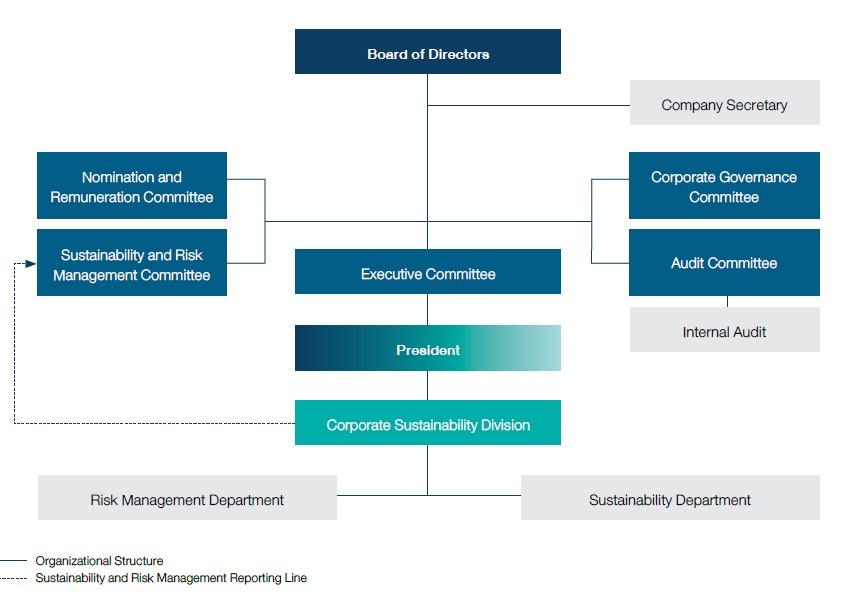
Risk Management Structure and Responsibilities
The Board of Directors is responsible for establishing the risk management policy, framework, and direction of the Group. This includes overseeing that the Company maintains an appropriate and comprehensive risk management system that aligns with business operations and relevant laws, as well as considering and acknowledging significant risk issues affecting the organization.
The Sustainability and Risk Management Committee assists the Board of Directors in establishing strategies, policies, and an enterprise-wide risk management framework. This includes integrating Environmental, Social, and Governance (ESG) factors into risk management by defining an Integrated Risk Management framework and plan. This framework covers business, operational, sustainability, and emerging risks, while ensuring regular monitoring and reporting to the Board of Directors.
The Audit Committee is responsible for overseeing the adequacy and effectiveness of the internal control system, risk management system, and internal audit processes. They review the Company's risk assessment and management systems to ensure they are appropriate, sufficient, and efficient, while reporting significant issues to the Board of Directors. This structure ensures that the Group’s risk management is systematic and transparent, supporting strategic decision-making and the organization’s stable, sustainable long-term growth.
The President is responsible for overseeing, managing, and driving operations in accordance with the policies and risk management framework approved by the Board of Directors. This ensures efficiency and alignment with the organization’s strategy by integrating risk management into strategic planning, executive decision-making, and operations at all levels. Furthermore, the role involves supervising senior management and relevant departments to ensure risks are managed appropriately to achieve organizational goals.
The Corporate Sustainability Division serves as the primary unit for integrating sustainability into business operations and risk management. It supports the identification, assessment, and management of Environmental, Social, and Governance (ESG) risks, as well as emerging risks. Furthermore, it coordinates the preparation of sustainability data and reports, while ensuring that risk management operations are fully aligned and comprehensive.
The Risk Management Department serves as the primary unit for executing and supporting the risk management processes across the Group. It collaborates with the Corporate Sustainability Division, as well as the Sustainability and Risk Management Working Group, to identify, assess, monitor, and review risks. Furthermore, the department is responsible for preparing reports on significant risks for submission to the President, the Sustainability and Risk Management Committee, the Audit Committee, and the Board of Directors.
2.1.2 Risk Management Process
The Company has adopted the COSO ERM 2017 international framework to establish a systematic risk management process. This encompasses risk identification, risk assessment, risk response, monitoring, and reporting, as detailed below:
Risk Identification : The Company identifies risks that may affect the achievement of organizational objectives and goals by considering both internal and external factors. This process covers strategic risks, operational risks, financial risks, and compliance risks, as well as social, environmental, and emerging risks. Risk identification is conducted through workshops, data collection from relevant departments, and analysis of business trends and environments.
Risk Assessment : After risk identification, the Company conducts a risk assessment by evaluating the likelihood and impact across various dimensions such as business operations, financial performance, financial position, and stakeholders to prioritize risks and provide essential data for determining risk management strategies aligned with the organization’s risk appetite.
Risk Response : The Company establishes risk management guidelines and measures appropriate to the nature and level of risk. These may include risk avoidance, reduction, transfer, or acceptance, with clearly defined responsible persons and action plans to ensure effective risk management that aligns with the corporate strategy.
Risk Monitoring & Review : The Company consistently monitors and reviews risk status and the effectiveness of risk mitigation measures. Enterprise risks are monitored monthly, while risk assessments are conducted quarterly. This ensures timely awareness of shifts in risk factors, allowing for the adjustment of measures to suit changing circumstances. Furthermore, existing risks are reviewed, and new emerging risks are identified on a quarterly basis.
Risk Reporting : Risk management results and significant risk issues are reported to the management, the Sustainability and Risk Management Committee, the Audit Committee, and the Board of Directors. These reports are used for policy formulation, strategic decision-making, and operational oversight to ensure that the Company’s risk management is transparent, effective, and aligned with good corporate governance principles.
Policy Document Link
https://amarin.co.th/app/uploads/2026/01/1%20%E0%B8%99%E0%B9%82%E0%B8%A2%E0%B8%9A%E0%B8%B2%E0%B8%A2%E0%B8%81%E0%B8%B2%E0%B8%A3%E0%B8%9A%E0%B8%A3%E0%B8%B4%E0%B8%AB%E0%B8%B2%E0%B8%A3%E0%B8%84%E0%B8%A7%E0%B8%B2%E0%B8%A1%E0%B9%80%E0%B8%AA%E0%B8%B5%E0%B9%88%E0%B8%A2%E0%B8%87%20%E0%B8%9A%E0%B8%B1%E0%B8%87%E0%B8%84%E0%B8%B1%E0%B8%9A%E0%B9%83%E0%B8%8A%E0%B9%89%201%20%E0%B8%A1.%E0%B8%84.69.pdf
Page Number in Report
1-2
Risk Factors — Overview
Risk Factors — Introduction
The Company recognizes risk factors that may impact business operations and competitiveness, arising from both internal and external sources. These factors could affect operational efficiency, revenue, and organizational stability. The primary risk factors encountered are as follows:
Risks to the Company's Business Operations
Risk Register
| Risk Name | Risk Characteristics | Consequences | Management Measures | Related Risk Factors |
|---|---|---|---|---|
| Risk from Economic Volatility | Economic volatility driven by economic slowdowns, inflation, and political and geopolitical uncertainties may lead to a decrease in consumer purchasing power and business spending. Specifically, clients may reduce or postpone budgets for marketing, advertising, and event activations, which are primary revenue sources for the Company. | Failure to promptly adapt strategies, business models, and cost management to shifting economic conditions may lead to higher production and service costs. This could result in diminished competitiveness, declining revenues and operating profits, increased performance volatility, and adverse impacts on the Company’s financial position and long-term growth potential. | 728 · Description: Volatility in the industry in which the company operates · Info category: STRATEGIC_RISK | |
| •Risk from Changes in Consumer Behavior | Changes in consumer behavior regarding media consumption, information channels, and purchasing decisions have been driven by various factors, including economic conditions, digital technology advancements, evolving lifestyles, and the influence of social media and influencers. These factors have transformed how consumers access media and information, making it more diverse than ever. Consequently, this shift has significantly reshaped the landscape of the media and advertising industries. | Such changes may lead to a slowdown in purchasing power and business spending, alongside a strategic reallocation of budgets toward digital and social media platforms. Consequently, corporate clients may reduce or adjust their advertising and marketing investments. Furthermore, the evolving media landscape has lowered entry barriers for new competitors, intensifying industry competition. These factors could impact the Company’s advertising revenue, event-related income, and overall competitiveness. | 729 · Description: Behavior or needs of customers / consumers · Info category: STRATEGIC_RISK | |
| Risks of demographic change | Demographic shifts such as the transition towards an aging society and declining birth rates along with differing behaviors and needs across generations, are driving rapid changes in demand for products, services, and media. Specifically, businesses and products targeting children and youth may face declining demand. In contrast, there is a growing trend toward content, media, and activities tailored to the elderly and working-age populations. This includes the event and exhibition industry, which must adapt formats and content to align with target audiences who are of varying ages with varying participation behaviors. | Failure to promptly and effectively align product strategies, content, and distribution channels with shifting demographic structures may result in declining revenue from existing customer bases, missed opportunities to reach new segments, and adverse impacts on market expansion, competitiveness, and long-term corporate growth. | 752 · Description: Impact from population structure · Info category: OPERATIONAL_RISK | |
| Technological change risk | The rapid development of technology, particularly digital technology, Artificial Intelligence (AI), and online platforms, has shifted business models and the structure of the media and publishing industry toward digital formats. This transition aims to accommodate consumer behavior, which now primarily relies on online platforms and social media. Consequently, companies must continuously adopt or develop new technologies to remain aligned with the evolving business environment. | Failure to appropriately and timely adopt or develop new technologies, or continued reliance on legacy systems and traditional processes, may lead to increased operating costs and diminished operational efficiency. This could adversely affect the Company's competitiveness against tech-driven peers, potentially impacting revenue, financial performance, and growth prospects in both the short and long term. |
| 1725 · Description: Income volatility · Info category: FINANCIAL_RISK · 1714 · Description: Competition risk · Info category: STRATEGIC_RISK |
| Personnel and Key Position Succession Risk | The Company's operations rely on personnel with specialized knowledge, competence, and experience, including executives and employees in key positions who play vital roles in shaping strategy, decision-making, and driving the business. If the Company is unable to retain key personnel, or if changes occur in key positions without an appropriate contingency plan including a lack of ready successors it may increase risks associated with reliance on specific individuals and impact the continuity of the organization's operations. | Such a situation may lead to a lack of operational continuity, delays in strategic decision-making, and a decline in operational efficiency. This could negatively impact the Company's competitiveness, as well as its business stability, revenue, and growth opportunities in both the short and long term. |
| 738 · Description: Reliance on employees in key positions · Info category: OPERATIONAL_RISK |
| Health and Safety Risks for Stakeholders | The Company's business operations involve employees, business partners, customers, and other stakeholders. Any accidents, unsafe incidents, or events impacting health and safety may lead to injuries, illnesses, or loss of life and property, as well as adversely affect the work environment and business activities. | Such incidents may impact business continuity, stakeholder confidence, and organizational reputation, while potentially leading to legal liabilities and associated costs. |
| 749 · Description: Safety, occupational health, and working environment · Info category: OPERATIONAL_RISK |
| Risks Associated with Business License Expiration and Regulatory Compliance | Amarin Television Co., Ltd., a subsidiary operating in the television media and digital TV station business, has been granted a license to use radio frequencies and operate a national commercial television service in the High Definition (HD) general category by the relevant regulatory authority. This license has a 15 year term and is set to expire in April 2029. Throughout the operational period under this license, the company must strictly comply with all laws, regulations, and conditions prescribed by the regulator. Any failure or omission to comply could pose a risk to the status of the license. | In the event that the company fails to comply with specified conditions, or if its licenses are revoked or cannot be renewed, it may have a significant impact on the television station’s operations, revenue, financial performance, and business continuity. |
| 730 · Description: Government policy · Info category: STRATEGIC_RISK |
| Risks Associated with Trade Account Collection | The Company may face risks regarding the collectability of accounts receivable, which can arise from various factors such as economic fluctuations, customers' financial liquidity, or payment delays. Such factors may lead to the risk of default or the occurrence of bad debts. | Inadequate management of accounts receivable risks could adversely affect the Company's cash flow, liquidity, and overall financial position. |
| 763 · Description: Default on payment or exchange of goods · Info category: FINANCIAL_RISK · 1725 · Description: Income volatility · Info category: FINANCIAL_RISK |
| Interest rate risk | The Company may be exposed to interest rate risks from financial institutions, particularly regarding its outstanding debt obligations. Fluctuations in interest rates could lead to changes in financing costs and interest expenses that deviate from previous projections. | If interest rates rise significantly, it could lead to higher financing costs, affecting the Company's performance, liquidity, and financial position. |
| 762 · Description: Change in financial and investment policies of financial institutions that affect business operations · Info category: FINANCIAL_RISK |
| Foreign exchange risk | The Company may be exposed to foreign exchange rate volatility, as certain expenses are denominated in foreign currencies. These include payments for machinery, raw materials, and other business-related operational costs. | Exchange rate volatility can lead to increased operating costs, impacting the Company's ability to control expenses, profit margins, and overall performance. Furthermore, it may affect financial planning and the Company's long-term financial stability. |
| 764 · Description: Fluctuation in exchange rates, interest rates, or the inflation rate · Info category: FINANCIAL_RISK |
| Compliance risks related to policies, laws, regulations, and relevant rules. | The Company's business operations must strictly comply with all relevant laws, rules, and regulations, which are subject to periodic changes, updates, or amendments. If the Company fails to monitor, understand, and adjust its operations to align with these evolving requirements comprehensively and in a timely manner, it may lead to regulatory non-compliance risks. | Non-compliance with laws and regulations may adversely impact business operations through stricter conditions or limitations. Furthermore, it may damage the Company’s reputation and corporate image, leading to risks of fines, legal penalties, or litigation all of which could ultimately affect operating results and stakeholder confidence. |
| 756 · Description: Change in laws and regulations · Info category: COMPLIANCE_RISK · 758 · Description: Violations of laws and regulations · Info category: COMPLIANCE_RISK · 759 · Description: Corporate Governance · Info category: COMPLIANCE_RISK · 1723 · Description: Legal risk · Info category: COMPLIANCE_RISK |
| Climate change risks | Climate change may impact the society, environment, and supply chains related to the Group's business operations particularly the publishing and book production sectors, which rely on natural resources such as paper. Climate change can affect ecosystems, forests, communities, and farmers involved in raw material sourcing. Additionally, uncertainty from increasingly extreme weather events may disrupt business activities, event organization, logistics, and product distribution. | Such risks may result in uncertainties regarding the quantity, quality, and continuity of long-term raw material procurement. Furthermore, they could lead to increased operating costs, delays in operations and product delivery, and ultimately impact business continuity and competitive advantage. |
| 739 · Description: Shortage or reliance on skilled workers · Info category: OPERATIONAL_RISK · 740 · Description: Shortage or fluctuation in pricing of raw materials or productive resources · Info category: OPERATIONAL_RISK · 1719 · Description: Climate change and disasters · Info category: STRATEGIC_RISK |
| Cybersecurity risks from increasing business reliance on technology | Given the rapid leaps in technology, companies are increasingly integrating digital systems into their operations to enhance speed and efficiency. However, a high level of reliance on information technology and digital systems may increase the risk of cyber threats, such as cyberattacks, data theft, or the leakage of sensitive company and stakeholder information. | A cybersecurity incident may lead to operational disruptions and system outages, potentially resulting in data loss and damage to the company’s reputation and stakeholder confidence. Furthermore, such incidents may incur legal liabilities, significant recovery and remediation costs, and adversely impact both short-term and long-term business performance. |
| 732 · Description: Changes in technologies · Info category: STRATEGIC_RISK · 750 · Description: Climate change and disasters · Info category: OPERATIONAL_RISK · 1719 · Description: Climate change and disasters · Info category: STRATEGIC_RISK · 1720 · Description: System disruption risk · Info category: OPERATIONAL_RISK |
| Risk of Human Resource Development Lagging Behind Technological Changes | The rapid advancement of digital technology, information technology, and Artificial Intelligence (AI) has led to swift changes that may cause current personnel skills and knowledge to become misaligned with present and future business demands. Failure by companies to timely enhance the skills and potential of their workforce to keep pace with these shifts could result in a significant skills gap. This gap increases organizational reliance on specialized experts or external resources to bridge the competency deficit. | Such circumstances may lead to a decline in operational efficiency and hinder the ability to leverage new innovations and technologies to their full potential. Furthermore, it may result in less accurate business decisions, affecting the Company’s long-term competitiveness, increasing operational costs, and heightening the risk of over-reliance on external resources. |
| 732 · Description: Changes in technologies · Info category: STRATEGIC_RISK |
| Risks of Negative Impacts from Artificial Intelligence (AI) Technology | Implementing Artificial Intelligence (AI) in business operations can lead to various negative risks across operational, legal, ethical, and reputational dimensions. These risks include inaccurate or biased AI outputs, violations of data privacy and intellectual property rights, over-reliance on technology, and the use of AI without proper and prudent governance. | Failure to manage the use of Artificial Intelligence in accordance with relevant laws, standards, and ethical principles may compromise data integrity and business decision-making. Such failure could diminish stakeholder confidence, result in reputational damage, lead to legal liabilities and associated costs, and ultimately impact the company’s financial performance and competitive advantage |
| 732 · Description: Changes in technologies · Info category: STRATEGIC_RISK |
Risks to Securities Holders' Investment
Risk Register
| Risk Name | Risk Characteristics | Consequences | Management Measures | Related Risk Factors |
|---|---|---|---|---|
| Major Shareholder Management Risk | As of December 31, 2025, the Adelfos Group comprising Wattanabhakdi Co., Ltd., Siriphakdeetham Co., Ltd., and Siriwattanabhakdi Co., Ltd. holds 904,368,591 shares, representing 90.59% (exceeding 75%) of the Company’s total paid-up shares. Consequently, this shareholder group maintains near-total control over shareholder meeting resolutions, including director appointments and other matters requiring a majority vote, except for those specifically required by law or company articles to pass by a three-fourths majority. | As a result, minority shareholders may be unable to aggregate sufficient votes to provide checks and balances against matters proposed by the major shareholder. |
| 2968 · Description: Risk of the company having a single shareholder holding >= 75% of shares · Info category: HOLDER_RISK |
| The Risk of Low Free Float Leading to Limited Trading Liquidity | As of December 31, 2025, a majority of the company's shares, totaling 904,368,591 shares or 90.59%, are held by three shareholders (the Adelfos Group). Meanwhile, minority shareholders (holding less than 149,742,239 shares or 15%) account for only 93,904,038 shares or 9.41%, distributed among 1,462 shareholders. Although the number of minority shareholders meets the Stock Exchange of Thailand's requirement of no less than 150 shareholders, their aggregate shareholding remains below the minimum threshold of 15% of the paid-up capital. Consequently, the Company's free float the proportion of shares available for trading in the secondary market remains at a low level. Such a limited free float proportion may result in low trading liquidity for the company's shares on the Stock Exchange. Share turnover in the secondary market could be minimal, potentially restricting trading access for general investors. Such a limited free float proportion may result in low trading liquidity for the company's shares on the Stock Exchange. | Share turnover in the secondary market could be minimal, potentially restricting trading access for general investors. Consequently, shareholders may face the risk of being unable to immediately sell their shares or sell at their desired price. | The Company recognizes the importance of complying with the Stock Exchange of Thailand (SET) regulations, particularly the requirement regarding the Free Float proportion, which must not be less than 15% of the paid-up capital. Currently, the Company is in discussions with its major shareholders to consider guidelines for restructuring shareholdings and increasing the minority shareholding proportion to meet the criteria and timeline specified by the Stock Exchange of Thailand. The Company is currently preparing and reviewing its business plan and relevant operational guidelines as follows:
| 2975 · Description: Risk from the stock having low free float, resulting in low trading liquidity · Info category: HOLDER_RISK |